09 August 2006

Google's analysis of click fraud detection

This 17-page report from Google's click quality team makes a lot of sense. Look at the US search engine conference speaker list for the past three years and witness the same names saying much the same things. Most of them represented click fraud detection services. I don't blame them for promoting their services and I don't claim to know how good they all were. There had been this figure of 30% click fraud bandied around as an industry norm. I have not seen this in the few accounts I have access to but I am not in a position to guess what it might be.

The Google report on third-party click fraud auditing is critical of poorly substantiated estimates of click fraud. Quote:

Over the last year, these estimates have received widespread media coverage. A different kind of report (from Outsell, Inc.) has also been widely cited for estimating the scope of the problem. But in fact that report did not measure click fraud – it was an opinion survey of advertisers asking them to guess at the extent of the problem. Thus the report’'s conclusions about the percentage of fraud and financial loss for the industry are essentially a poll of the perception of the size of the problem (with the backdrop of the previous coverage of high estimates) rather than actual size of the problem. This is analogous to estimating crime rates in a country by asking some residents how much crime they think there is, and averaging those guesses to state that number is the actual rate.

The main problem seems to be fictitious clicks of two kinds:

  • Fictitious clicks due to detection of page reloads as ad clicks.

  • Fictitious clicks due to conflation across advertisers and ad networks.
The page-reloading behaviour problem is handled very nicely by Visitlab. Their reporting shows a visitor's path through the site and shows the initial paid click and subsequent traversals of the same page as internal clicks. A poorly designed click fraud detection mechanism might show each reload as a separate click.


In the early days of Visitlab, such clicks showed as multiple (suspicious) clicks but no more.

I have not seen the second kind of problem, where each click goes through a third party audit service and clicks within the site are counted, as are clicks arising on another advertiser service such as Overture/Yahoo.

07 August 2006

Blatant invitation to click ads


This was seen two days ago at a publisher site and the AdSense is still showing regular ads. Search for the text you can see in the image and find the URL.

03 August 2006

IAB announces the formation of industry-wide Click Measurement Working Group

It is heartening to read about the formation of a working group comprising the major PPC ad companies including Ask.com, Google, LookSmart, Microsoft and Yahoo!. They will initially define Click Measurement Guidelines, thereby defining a click.

Although this is a start, I'd like to see a consortium of such companies team up with other major web sites such as Amazon and eBay to develop what I loosely refer to as an "IP address score". It would be a multidimensional, not flat numeric, score, and be available to consortium members to use as an additional input to their own proprietary click quality algorithms. It could have other uses outside this click fraud space.

27 July 2006

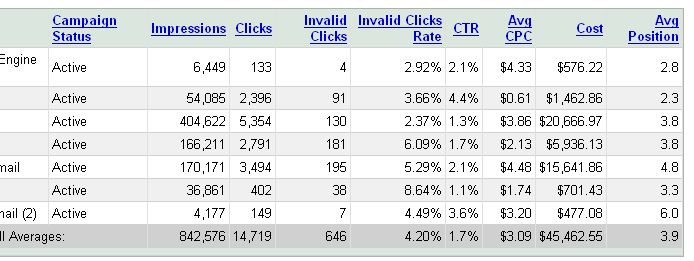
Google AdWords lifts veil (a little)


Finally, Google has bowed to pressure and given advertisers a way to see what it calls "invalid clicks". Anyone managing a large account has known that Google chucks random little amounts as account credits, which are explained as refunds for invalid clicks.

I have said in this blog for some time and in WIRED magazine that Google is good at keeping click fraud at bay, so I am not surprised to see a low rate of invalid clicks in one account.

Several participants in the AdWords forum on Webmasterworld have shared their own invalid click statistics. It seems to be below 4% for most of the posters.

But it all depends on the total spend. For a $45,000 spend, 4.2% is worth $1900 of savings because Google detected it. For a $65,000 spend, 3.7% invalid clicks add up to $2400. Advertisers can still speculate how many invalid clicks won't be picked up by Google. The "get paid to read ads" scams are still around.

Back to the WW discussion, europeforvisitors made a good point, "ROI is what determines whether an advertiser is in or out." Many advertisers seem to treat invalid clicks just as a retailer treats shoplifting - as long as the ROI is good, click fraud is part of the cost of doing business.

There is still a place for independent click fraud detection services. It would be great if Google were to release some more information about those invalid clicks - where they came from, IP addresses, time of day, number of clicks from each source. This is unlikely to happen, as it would drag Google into lawsuits between advertisers and the alleged invalid clickers.

19 July 2006

The sun rises in the East (YAOAACF)

eMarketer cites a company that is offering a $495, 27-page report on how much money is being lost to click fraud. I think there is money to be made is by writing about the click fraud threat. Now why didn't I think of that?

At least we agree that there is growing apathy towards CF in advertiser land.

14 July 2006

Bruce Schneier YAOAACF

Bruce Schneier has discovered two of the four or five kinds of click fraud as seen in this YAOAACF (Yet Another Obligatory Article About Click Fraud). Nothing new there, but he mentions fraud in online gaming activities and cost-per-action (CPA) ads.

Ah well, that should fulfil July's quota of click fraud articles.